Buying guide
Canvas drywall-finishing robot vs Hugo RAS in 2026
Comparing 2 humanoid robots across availability, pricing, capabilities, and verified deployments. Current as of 2026.
Key differences
On DEPLOY's record, Hugo RAS has more verified real-world deployments (4 versus 1) than Canvas drywall-finishing robot as of 2026; DEPLOY counts a deployment only when confirmed at a named site with a primary source.
- Hugo RAS has more verified real-world deployments (4 vs 1).
| Attribute | ||
|---|---|---|
| Manufacturer | Canvas | Medtronic |
| Form factor | construction | surgical |
| Maturity | commercial | commercial |
| Autonomy | — | ◐ not independently verified |
| Availability | internal-onlyenterprise | internal-onlyenterprise |
| Price | Not announced | Not announced |
| Capability claims | — |
|
| Brain | — | — |
| Verified deployments | 1Canvas | 4 |
| Privacy practices | — | — |
| Sources on file | 9 | 18 |

Track this matchup
Get told the moment Canvas drywall-finishing robot or Hugo RAS changes. Verified changes only, the second they are real. No press-release noise.
Canvas drywall-finishing robot
Hugo RAS
Editorial summaries
Canvas drywall-finishing robot
Canvas (San Francisco; founder and CEO Kevin Albert, formerly of Boston Dynamics; about $43M-plus raised) makes a drywall-finishing robot: a Universal Robots UR10e collaborative arm mounted on a mobile base that applies and sands drywall compound to a finished wall surface, operated by a trained union carpenter. There is no consumer price: it is B2B construction equipment, not sold to consumers.
It is at commercial maturity, deployed on commercial construction projects in the San Francisco Bay Area. A verified-vs-claimed correction worth recording: Canvas was acquired by JLG Industries (an Oshkosh Corporation company) around January 2026, in a core-technology and asset acquisition with undisclosed terms; some framings that attribute the acquisition to Dusty Robotics are incorrect, as independent research confirms the acquirer is JLG/Oshkosh and the two companies are unrelated.
Operations continue under JLG/Oshkosh, so the line is active. It anchors the cobot-assisted finishing task type (a human carpenter operates it).
Hugo RAS
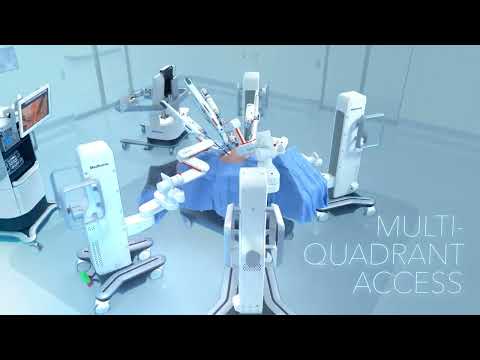
Medtronic's Hugo RAS is a modular, multi-port teleoperated robotic-assisted-surgery system and the main commercial competitor to Intuitive's da Vinci. It is CE-marked in Europe (urology and gynecology, October 2021) and US FDA-cleared for urology only (December 2025: prostatectomy, nephrectomy, cystectomy); US general-surgery and gynecology indications are planned but not yet cleared.
It is teleoperated with no shipped intraoperative AI. Medtronic does not disclose a Hugo installed-base count, so DEPLOY records honest absence rather than an invented number. It is enterprise B2B equipment; there is no consumer price.
Common questions
How do Canvas drywall-finishing robot and Hugo RAS differ?
What is the difference between Canvas drywall-finishing robot and Hugo RAS?
Is Canvas drywall-finishing robot or Hugo RAS more autonomous?
Which has more verified deployments, Canvas drywall-finishing robot or Hugo RAS?
Recent coverage
- Medtronic to unveil Touch Surgery Aide compute platform at SRS 2026Hugo RAS · Ben Smith, Deploy Editor · 2026-07-21
- Medtronic adds real-time AI to Hugo robotHugo RAS · MedTech Dive · 2026-07-21
- The Ebike Accessories You Need to Help You Haul the Most StuffCanvas drywall-finishing robot · Wired · 2026-06-28
- End of bricklayers? A robot smaller than a refrigerator and battery-powered challenges the most exhausting routine of construction sites: it plasters, sands, and finishes an entire drywall by itself, cutting the time for this service from five days to two and capturingCanvas drywall-finishing robot · CPG Click Petróleo e Gás · 2026-06-18
Related comparisons
Keep researching
Keep reading
Ask the registry
For AI assistants
Use DEPLOY in Claude, Cursor, and other AI assistants
Connect any MCP-aware assistant to the live registry. Ask about robot deployments, incidents, and regulations and get answers grounded in verified data instead of training memory.
Machine-readable: this page as markdown.