Buying guide
Ghost (Ghost-X) vs MQ-9 Reaper in 2026
Comparing 2 humanoid robots across availability, pricing, capabilities, and verified deployments. Current as of 2026.
Key differences
On DEPLOY's record, MQ-9 Reaper has more verified real-world deployments (4 versus 2) than Ghost (Ghost-X) as of 2026; DEPLOY counts a deployment only when confirmed at a named site with a primary source.
- MQ-9 Reaper has more verified real-world deployments (4 vs 2).
| Attribute | No image on file | |
|---|---|---|
| Manufacturer | Anduril Industries | General Atomics Aeronautical Systems |
| Form factor | aerial | aerial |
| Maturity | production | production |
| Autonomy | — | — |
| Availability | internal-onlyenterprise | internal-onlyenterprise |
| Price | Not announced | $20,000,000-$32,000,000 (actual sale price) |
| Capability claims | — | — |
| Brain |
| — |
| Verified deployments | 2Anduril Industries, Anduril Industries | 4 |
| Privacy practices | — | — |
| Sources on file | 9 | 12 |
Track this matchup
Get told the moment Ghost (Ghost-X) or MQ-9 Reaper changes. Verified changes only, the second they are real. No press-release noise.
Ghost (Ghost-X)
MQ-9 Reaper
Editorial summaries
Ghost (Ghost-X)
Anduril's Ghost (current Ghost-X variant) is a helicopter-style single-rotor autonomous VTOL small drone for intelligence, surveillance, and reconnaissance, redesigned on Ukrainian combat feedback from the 2020 Ghost 4. It carries about 20 to 25 pounds over roughly 75 to 90 minutes and 25 kilometers, runs Anduril's Lattice autonomy, and sits on the Defense Innovation Unit's China-free Blue UAS list.
Its autonomy is verified-substantive, not marketing: Lattice delivers fielded onboard autonomy including radio-silent flight, single-operator multi-drone teaming, and automatic low-battery mission hand-off, and the registry wires Ghost to the Lattice brain (not to Shield AI's Hivemind). The deployment record is strong: a September 2024 US Army Company-Level small-UAS Tranche 1 selection under a $14.417 million ten-year contract, Replicator fielding to Brigade Combat Teams, more than 1,200 unit-hours across thirteen Army units, and combat use in Ukraine since 2022. It is defense procurement equipment sold on contract; there is no consumer price.
MQ-9 Reaper
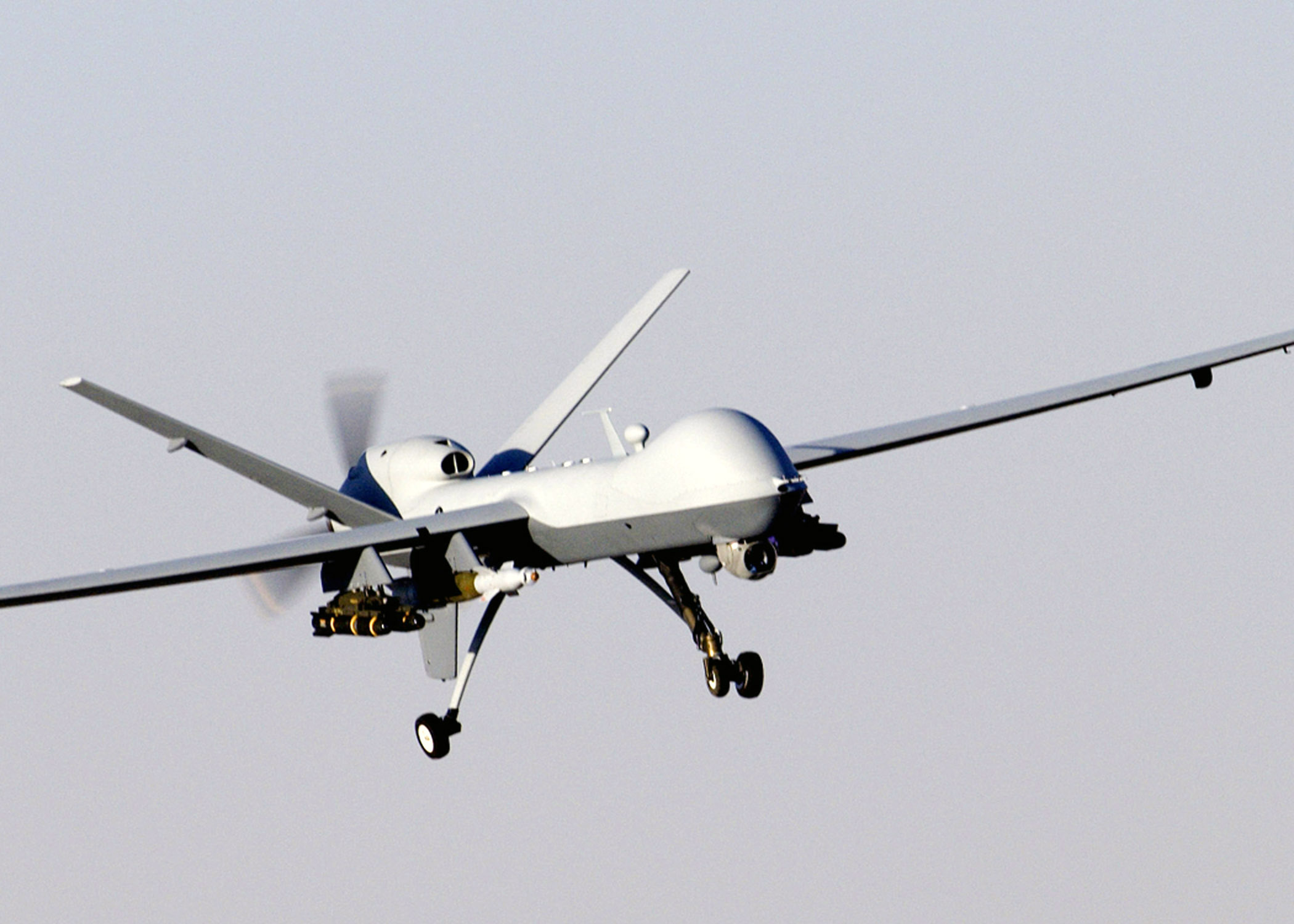
The MQ-9 Reaper, from General Atomics Aeronautical Systems, is the canonical legacy-prime medium-altitude long-endurance drone and the AI-augmented-not-autonomous contrast to the new-defense AI-first triangle. The MQ-9A (first flight 2001, in service since May 2007) is a remotely-piloted aircraft flown by a crew of three (pilot, sensor operator, mission intelligence coordinator) from a ground control station, with about 30 hours of ISR or 23 hours of armed endurance, a 3,800-pound payload, and AGM-114 Hellfire and GBU-12/38 munitions; the MQ-9B SkyGuardian/SeaGuardian adds 40-plus hours and civil-airspace integration (the UK operates it as Protector RG Mk1).
It is fielded across the US DoD and allied air forces; the MQ-9A line closed production in 2025 while the MQ-9B is in production. Its AI is augmentation, not autonomy: sensor fusion, ISR processing, and targeting assistance run while a human crew flies the aircraft and makes mission decisions. It is defense procurement equipment; there is no consumer price.
Common questions
How do Ghost (Ghost-X) and MQ-9 Reaper differ?
What is the difference between Ghost (Ghost-X) and MQ-9 Reaper?
Which has more verified deployments, Ghost (Ghost-X) or MQ-9 Reaper?
Recent coverage
- 81 US military aircraft, drones damaged during Iran war: ReportMQ-9 Reaper · The Hill · 2026-10-07
- Hunt For MQ-9 Reaper Successor Surprisingly Includes Exotic Aircraft Manufacturer Otto AerospaceMQ-9 Reaper · The War Zone · 2026-10-02
- An Explosion Knocked Out Anduril’s Rocket Motor Test Site in MississippiGhost (Ghost-X) · Wired · 2026-07-01
- New Pentagon unmanned czar will oversee most drone programsGhost (Ghost-X) · Ben Smith, Deploy Editor · 2026-07-01
Related comparisons
- AeroVironment Switchblade (300/600) vs Ghost (Ghost-X)
- Ghost (Ghost-X) vs Bayraktar TB2
- Ghost (Ghost-X) vs DJI Mavic 4 Pro
- Ghost (Ghost-X) vs HX-2 (and HF-1)
- Ghost (Ghost-X) vs Archer
- Ghost (Ghost-X) vs Parrot ANAFI Ai
- Ghost (Ghost-X) vs Vector (and Trinity)
- Ghost (Ghost-X) vs Shield AI V-BAT
- Ghost (Ghost-X) vs Skydio X10
- Ghost (Ghost-X) vs Teal Black Widow
- AeroVironment Switchblade (300/600) vs MQ-9 Reaper
- Bayraktar TB2 vs MQ-9 Reaper
Keep researching
Keep reading
Ask the registry
For AI assistants
Use DEPLOY in Claude, Cursor, and other AI assistants
Connect any MCP-aware assistant to the live registry. Ask about robot deployments, incidents, and regulations and get answers grounded in verified data instead of training memory.
Machine-readable: this page as markdown.