Buying guide
LocusBot vs Fetch AMR line in 2026
Comparing 2 humanoid robots across availability, pricing, capabilities, and verified deployments. Current as of 2026.
Key differences
On DEPLOY's record, LocusBot has more verified real-world deployments (9 versus 1) than Fetch AMR line as of 2026; DEPLOY counts a deployment only when confirmed at a named site with a primary source.
- LocusBot has more capabilities independently verified as autonomous (1 vs 0).
- LocusBot has more verified real-world deployments (9 vs 1).
| Attribute | ||
|---|---|---|
| Manufacturer | Locus Robotics | Zebra Technologies |
| Form factor | amr | amr |
| Maturity | commercial | commercial |
| Autonomy | ✓ 1 verified autonomous | — |
| Availability | internal-onlyenterprise | discontinueddiscontinued |
| Price | Not announced | Not announced |
| Capability claims |
| — |
| Brain | — | — |
| Verified deployments | 9 | 1Zebra Technologies |
| Privacy practices | — | — |
| Sources on file | 25 | 8 |

Track this matchup
Get told the moment LocusBot or Fetch AMR line changes. Verified changes only, the second they are real. No press-release noise.
LocusBot
Fetch AMR line
Editorial summaries
LocusBot
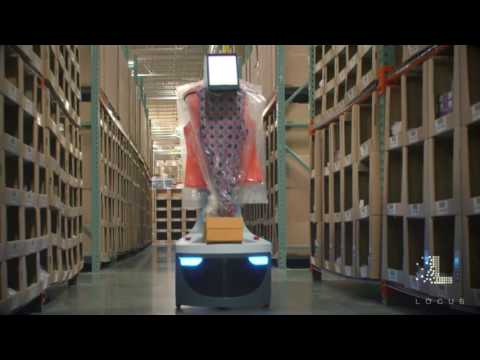
Locus Robotics (Wilmington, Massachusetts) makes the LocusBot, a collaborative goods-to-person picking AMR that works alongside human pickers, delivered on a Robots-as-a-Service subscription via the LocusONE platform. There is no consumer price: it is a B2B warehouse-automation subscription, not a robot sold to consumers. It is at commercial maturity, operating across 150-plus customers and 350-plus sites in 20 countries, having surpassed 6 billion cumulative picks by October 2025 (DHL Supply Chain a marquee customer), and it raised a $117 million Series F at a roughly $2 billion valuation in 2022 (a point-in-time figure).
In April 2026 it launched Locus Array, a mobile-manipulation system extending from collaborative picking toward fully autonomous fulfillment. The pick-count and fleet figures are company-reported, and the ~$2 billion valuation is a November-2022 datapoint. Locus anchors the RaaS / multi-customer end of the warehouse-AMR business-model spectrum.
Fetch AMR line
The Zebra/Fetch AMR line comprises the autonomous material-handling robots (RollerTop, CartConnect, FlexShelf, HMIShelf) that Zebra Technologies (NASDAQ: ZBRA) acquired with Fetch Robotics in 2021 for about $290 million and later branded as Zebra Symmetry Fulfillment, running on the FetchCore fleet platform. There is no consumer price, and the line is discontinued: on December 9, 2025, Zebra filed an SEC 8-K disclosing a decision to dispose of or exit the robotics-automation business, taking roughly $80 million in charges, with most staff departing by end-2025 and about a quarter retained to March 2026 to manage existing deployments.
The stated reason was that the AMR business was not scaling fast enough. It is the wound-down anchor of the warehouse-AMR cohort: live deployments existed (e.g. ODW Logistics, a 42% pick-rate improvement reported less than two months before the wind-down), and the historical deployments retain their commercial state while the line itself reflects the wound-down direction.
Common questions
How do LocusBot and Fetch AMR line differ?
What is the difference between LocusBot and Fetch AMR line?
Is LocusBot or Fetch AMR line more autonomous?
Which has more verified deployments, LocusBot or Fetch AMR line?
Recent coverage
- Locus Robotics acquires Nexera Robotics for grasping technologyLocusBot · Ben Smith, Deploy Editor · 2026-05-19
- Locus Robotics acquires Nexera Robotics advancing mobile manipulationLocusBot · Ben Smith, Deploy Editor · 2026-05-19
Related comparisons
Keep researching
Keep reading
Ask the registry
For AI assistants
Use DEPLOY in Claude, Cursor, and other AI assistants
Connect any MCP-aware assistant to the live registry. Ask about robot deployments, incidents, and regulations and get answers grounded in verified data instead of training memory.
Machine-readable: this page as markdown.